The Complete Guide to Improving Google Ads Lead Quality
Written by Joshua Makin
Managing paid search campaigns in 2026 is not just about generating more traffic. For many businesses, traffic is now the easy part, especially with Performance Max, Demand Gen and automated bidding doing more of the heavy lifting.
The real challenge is lead quality.
At Talking Stick Digital, we often audit Google Ads accounts that appear healthy on the surface. Click-through rates look strong. Cost per lead looks efficient. Conversion volume is moving in the right direction.
Then we look at the customer relationship management system, or CRM, and the picture changes.
Sales teams are often overwhelmed by low-quality enquiries, spam submissions, poor-fit prospects and leads that were never likely to become revenue. In those cases, the campaign is not really succeeding. It is simply generating form fills.
To improve Google Ads lead quality, businesses need to move beyond basic conversion tracking and start optimising around value, intent and actual commercial outcomes.
Key Takeaways
- Lead quality improves when Google Ads is trained to optimise for revenue-driving prospects, not just form submissions.
- Value-Based Bidding helps Google understand which conversions are worth more to your business.
- Offline Conversion Tracking connects Google Ads with real CRM, booking or sales data.
- Ad copy, landing pages and form design should help pre-qualify users before they become leads.
- A higher cost per lead is not always a problem if the cost per qualified lead and Customer Acquisition Cost improve.
How Has Lead Quality Changed in 2026?
Lead generation has become more automated, but that does not mean it has become more accurate.
Google’s automation can be extremely powerful, but it depends on the quality of the data it receives. If every enquiry is treated equally, the system will naturally try to find more of the cheapest enquiries. That might reduce your cost per lead, but it can also attract the wrong type of prospect.
This is especially important for businesses where different leads have very different commercial values. A private school, healthcare provider, B2B software company, professional services firm or high-value ecommerce brand cannot afford to judge all enquiries in the same way.
A contact form submission is not the final outcome. It is only the start of the journey.
The better question is: which leads become qualified opportunities, attended appointments, consultations, bookings, customers or long-term revenue?
That is where advanced PPC optimisation needs to focus.
How Can You Reclaim Control Over User Intent?
The first step in improving lead quality is understanding the intent behind the search.
Broad Match, Smart Bidding and automated campaign types can all play a useful role. However, if they are used without structure, they can quickly spend budget on searches that are too vague, too informational or too far away from purchase intent.
High-intent keywords should be isolated within campaigns or ad groups where you can control budget, messaging and bidding strategy more carefully. These are the searches that show clear commercial intent, such as users actively looking for a provider, service, product, appointment, consultation or quote.
For example, a search like “private dentist consultation near me” is likely to have a very different value from “how much does dental treatment cost”. Both may be relevant at different stages, but they should not always be treated in the same way.
Search term reviews remain essential. Negative keywords should be applied systematically to remove irrelevant traffic, including unsuitable locations, free resources, DIY searches, job seekers, competitor confusion or low-intent research queries.
This does not mean narrowing the account so much that it cannot grow. It means giving Google a clearer framework so automation has better boundaries to work within.
How Does Value-Based Bidding Improve Lead Quality?
Value-Based Bidding is one of the most important levers for improving Google Ads lead quality.
The problem with standard conversion tracking is that it often treats every conversion as equal. A brochure download, contact form, phone call and high-value consultation request may all be counted as “leads”, even though their commercial value is very different.
Value-Based Bidding changes that.
Instead of telling Google that every conversion has the same value, you assign different values to different conversion actions, lead types or customer outcomes. This gives the algorithm a better understanding of what your business actually wants.
For example, a school admissions enquiry for an Early Years place may hold a much higher lifetime value than an enquiry for a student joining in Year 10. The Early Years student may remain at the school for many years, while a Year 10 student has a shorter potential fee window.
From a basic lead generation perspective, both enquiries may look equal.
From a revenue perspective, they are not.
When those values are passed back into Google Ads, Smart Bidding can start to optimise towards higher-value enquiries, rather than simply chasing the cheapest form submissions.
tCPA vs tROAS: What Is the Difference?
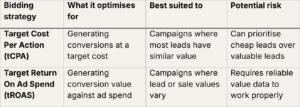
Target Cost Per Action can still be useful, especially when conversion values are fairly consistent. However, for businesses with varied lead values, target Return On Ad Spend often provides a stronger foundation.
The goal is not just to pay less for leads. The goal is to bid more intelligently for the leads most likely to become revenue.
How Does Offline Conversion Tracking Close the Feedback Loop?
Offline Conversion Tracking connects Google Ads with what happens after the enquiry.
Without Offline Conversion Tracking, Google Ads often loses visibility once a user submits a form, calls the business or books an appointment. From the platform’s perspective, the conversion has already happened.
In reality, the most important stages often happen later.
A lead might become qualified in HubSpot or Salesforce. A consultation might be attended. A quote might be accepted. A table booking might turn into a high-value restaurant visit. A healthcare enquiry might become a paid procedure. A Shopify order might reveal which campaign actually drove profitable revenue.
Offline Conversion Tracking allows those later-stage outcomes to be sent back into Google Ads.
This helps the algorithm learn which clicks, keywords, audiences and campaigns are more likely to generate genuine commercial value.
How Do You Implement Offline Conversion Tracking?
A simple Offline Conversion Tracking process usually looks like this:
- A user clicks a Google Ad.
- Google generates a Google Click ID, known as a GCLID, which identifies the ad click.
- The user submits a form, books an appointment or completes another lead action.
- The GCLID is stored in the CRM, booking platform or lead database.
- The sales or admin team updates the lead as qualified, attended, won, lost or another relevant milestone.
- That offline data is uploaded or synced back into Google Ads.
- Google uses that data to optimise future bidding decisions.
In some cases, Enhanced Conversions can also be used to send hashed first-party data, such as email addresses or phone numbers, back to Google. This can help improve matching where GCLID data is incomplete.
This process does require technical setup, but it is one of the most valuable improvements a business can make to lead generation campaigns.
How Can Ad Copy Pre-Qualify Better Leads?
Ad copy should not only attract clicks. It should help attract the right clicks.
For businesses with a clear target customer, the ad itself can be used to filter unsuitable prospects before they enter the funnel. This can be done through pricing, positioning, audience cues, service level or minimum requirements.
For example, a B2B software provider might include “Enterprise software for multi-site teams” rather than a vague message about “simple software for every business”. A high-value service provider might mention “consultations from £X” if price transparency helps reduce poor-fit enquiries.
This may reduce click volume, but that is not always a problem. If fewer unsuitable users click the ad, the business saves budget and the sales team receives fewer low-quality leads.
Strong lead generation copy should make three things clear:
- Who the service is for
- What problem it solves
- What level of commitment or fit is expected
That clarity helps Google Ads performance, but it also improves the experience for users.
Should Landing Pages Add More Friction?
Landing page friction is not always a bad thing.
For years, conversion rate optimisation has often focused on reducing friction. Shorter forms, fewer steps and simpler calls to action can all increase conversion volume. But when lead quality is the main issue, removing too much friction can make the problem worse.
A high-volume form is not valuable if most of the enquiries are unsuitable.
The better approach is to use intentional friction. This means adding the right qualifying questions without making the process feel unnecessarily difficult.
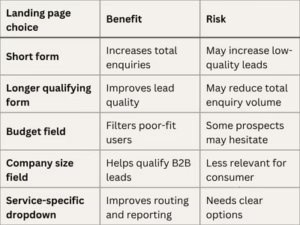
The right balance depends on the business model.
A high-volume ecommerce lead magnet may benefit from a shorter form. A high-ticket B2B service, private healthcare clinic, school or specialist consultancy may benefit from more qualification.
The goal is not to make the form difficult. It is to make sure the people who complete it are more likely to be a good fit.
What Metrics Should You Use Instead of Cost Per Lead?
Cost per lead is useful, but it should not be the main measure of success when lead quality matters.
A campaign can reduce cost per lead while increasing wasted sales time. That is not efficient growth.
More useful metrics include:
- Cost Per Qualified Lead
- Lead-to-sale conversion rate
- Cost Per Acquisition
- Customer Acquisition Cost, also known as CAC
- Return on Ad Spend
- Lead value by campaign
- Revenue by keyword or audience segment
- Appointment attendance rate
- Quote acceptance rate
These metrics bring the focus back to business outcomes.
For example, a campaign generating leads at £40 each may look better than one generating leads at £90 each. But if the £90 leads convert into customers at a much higher rate, the more expensive lead may be the better investment.
This is where PPC reporting needs to move beyond platform-level performance and into commercial performance.
How Long Does Value-Based Bidding Take to Work?
Value-Based Bidding requires enough conversion data for Google to identify meaningful patterns.
As a practical benchmark, campaigns usually need at least 30 to 50 relevant conversions within a 30-day period before the algorithm has enough data to optimise effectively. During the initial learning phase, performance may fluctuate as the system adjusts to the new signals.
This is normal.
The key is to avoid judging the strategy too quickly. Value-Based Bidding needs clean data, consistent conversion values and enough time to learn which users are most likely to generate revenue.
For lower-volume accounts, it may be better to start by importing qualified lead milestones before moving towards more advanced revenue-based bidding.
Can You Improve Lead Quality Without a CRM?
Yes, although a CRM makes the process easier.
If a business does not use a CRM, offline conversion data can still be uploaded manually using a spreadsheet or CSV file. The important requirement is that each lead can be matched back to the original ad interaction, either through a GCLID or through hashed first-party data.
A simple setup might involve:
- Capturing the lead source and GCLID on form submission
- Recording whether the lead became qualified
- Updating whether the lead became a sale, booking or attended appointment
- Uploading that data back into Google Ads at regular intervals
This is not as seamless as a CRM integration, but it is still far better than optimising only for raw enquiries.
Will Improving Lead Quality Increase Cost Per Lead?
It can do, but that is not automatically a problem.
When campaigns are refined around stronger intent, better qualification and higher-value conversions, low-quality enquiries are likely to reduce. That can push the average cost per lead up.
However, the more important measure is what happens after the lead is generated.
If Cost Per Qualified Lead falls, Customer Acquisition Cost improves and sales teams spend less time on poor-fit enquiries, the campaign is performing better, even if the headline cost per lead is higher.
A lower cost per lead only matters if those leads can become customers.
How Can You Future-Proof PPC Revenue?
The future of PPC lead generation is not about generating as many conversions as possible. It is about generating the right conversions and giving the algorithm the data it needs to find more of them.
That means tightening keyword intent, using Value-Based Bidding, connecting offline conversion data, improving landing page qualification and measuring success against actual commercial outcomes.
At Talking Stick Digital, we help businesses move beyond basic form-fill tracking and build PPC strategies around revenue, lead quality and long-term performance.
If your sales team needs better enquiries rather than simply more enquiries, it is time to stop optimising for volume alone and start bidding on value.