What Is E-E-A-T and Why Is It Fundamental for SEO?
Written by Joshua Makin
Anyone who has worked around SEO over the last few years will know how quickly the discipline can change. Google’s core updates, evolving quality guidance and the growing presence of AI Overviews have all made one thing clear: quality matters more than volume.
Ranking well is no longer just about placing the right keywords in the right places, building links and making sure your pages can be crawled. Those things still matter, but they are only part of the picture.
Today, strong SEO is built around usefulness, credibility and trust. A page needs to answer the query, but it also needs to make the user feel confident in the answer. Who created the content? Why should they be trusted? Is the advice backed by real knowledge, first-hand experience or clear evidence? Does the wider website support what the page is claiming?
That is where E-E-A-T comes in.
E-E-A-T stands for Experience, Expertise, Authoritativeness and Trust. It is a framework used in Google’s Search Quality Rater Guidelines to assess whether content is helpful, reliable and credible.
Google’s own guidance says its automated systems are designed to prioritise helpful, reliable, people-first content, rather than content created primarily to manipulate search rankings – a tactic used in the early days of SEO.
For businesses, E-E-A-T is important because it connects SEO with something much bigger than rankings. It asks whether your website genuinely demonstrates why your brand should be found, trusted and chosen.
At Talking Stick Digital, this aligns closely with how we think SEO should work. Strong organic visibility rarely comes from shortcuts. It comes from clear strategy, technical foundations, useful content, honest recommendations and a website that properly reflects the expertise behind the business.
Key Takeaways
- E-E-A-T stands for Experience, Expertise, Authoritativeness and Trust.
- It is not a direct ranking score, but it reflects the quality signals Google wants helpful content to demonstrate.
- Trust is the foundation of E-E-A-T. If a page or website cannot be trusted, the other elements carry less weight.
- E-E-A-T applies across the whole website, not just blog content.
- Strong E-E-A-T supports SEO, conversions and AI visibility by making your content easier to understand, verify and trust.
What Is E-E-A-T in SEO?
E-E-A-T is a quality framework used to assess the credibility and reliability of online content. In SEO, it helps us understand what search engines are trying to reward when they surface helpful, trustworthy results.
The acronym stands for:
- Experience
- Expertise
- Authoritativeness
- Trust
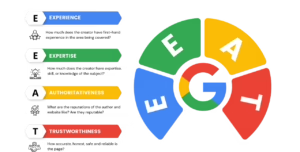
Although E-E-A-T is often discussed as if it is a direct ranking factor, that is not quite accurate. There is no E-E-A-T score in Google Search Console, and you cannot add a single piece of code to “fix” it. Instead, it is better understood as a set of quality principles that should shape your content, website structure, brand signals and overall SEO strategy.
Experience
The first of the E’s ‘Experience’ is about presenting first-hand involvement around a particular topical pillar.
This could mean presenting a product, delivering a service, visiting a destination, managing a campaign, testing a process or solving the type of problem being discussed within a piece of content and the wider site. Adding authors to your site who have first-hand experience and an online footprint of industry knowledge can be an advantageous experience signal to the search engine. Experience gives content a level of practical detail and authenticity to search crawlers that purely generic information often lacks.
For example, a blog about Dubai tips written by someone who has actively visited and has first-hand experiences should feel different from a page that simply rewrites from other websites. The experienced version is more likely to mention real issues, common patterns, practical tips and small details that only come from having actually been there.
This matters because users are increasingly good at spotting content that feels thin. AI-generated summaries copied competitor structures and surface-level advice may be easy to produce, but they rarely provide the level of insight and originality needed to build trust.
In SEO content, experience often shows up through:
- Real examples
- Original observations
- Screenshots or process detail
- Case studies
- Client scenarios
- Clear explanations of what happens in practice
Expertise
Expertise reflects the depth of knowledge behind the content.
A page demonstrates expertise when it explains a topic accurately, handles nuance well and answers the questions a user is likely to have next. This is especially important in industries where poor advice can have serious consequences, such as finance, healthcare, legal services, safety, education and other “Your Money or Your Life” topics.
However, expertise still matters in less sensitive sectors. A B2B buyer researching specialist equipment or a parent choosing a school all need content that feels informed and reliable.
It’s important to clarify that expertise does not mean using technical language; it’s about tailoring your expertise and tone to the target audience. For instance, if you’re trying to reach a general B2C audience through a troubleshooting guide, they do need to understand what matters and why it matters, but they also need to be able to understand the content or they might bounce off the site.
Authoritativeness
Authoritativeness is about reputation.
It asks whether the author, brand or website is recognised as a credible source on the topic. That recognition can come from many places: backlinks, brand mentions, reviews, case studies, digital PR, awards, client results, partnerships, industry contributions or consistent publishing around a specialist area.
This is why we recommend building content around topical focuses as opposed to traditional one-page one-keyword pieces. While a single blog post can demonstrate expertise, organic authority is built from covering all aspects of a topic in depth and showing the user (and therefore the search engine) that your website is a useful place to learn about a subject.
Authority is also reinforced by internal linking. If a page about E-E-A-T connects naturally to related content on content strategy, technical SEO, AI visibility and analytics, it helps users and search engines understand that the site has depth around the topic.
Trust
Google has described trust as the most important member of the E-E-A-T family because untrustworthy pages have low E-E-A-T, regardless of how much experience, expertise or authority they appear to have.
Trust is built through accuracy, transparency and consistency. Users should be able to understand who is behind the content, what the page is trying to do, whether claims are supported, and how to contact the business if needed.
Trust signals can include:
- Clear business information
- Visible contact details
- Honest service descriptions
- Case studies and testimonials
- Author or reviewer information
- Secure browsing
- Clear policies
- Reliable sources
- Content that is regularly reviewed and updated
For SEO, trust is where the website and the brand need to work together. A well-written article can only do so much if the wider site feels unclear, outdated or difficult to verify.
A Brief History of E-E-A-T
The Start of E-A-T
The E-E-A-T framework was first introduced in 2014 as E-A-T, standing for Expertise, Authoritativeness and Trustworthiness within Google’s Search Quality Rater Guidelines.
These guidelines were used by human quality raters to assess the quality of search results and help Google understand whether its systems are surfacing useful, reliable information.
At first, E-A-T was especially targeted to what Google calls Your Money or Your Life topics. These are subjects where poor or misleading advice could affect someone’s health, finances, safety or wellbeing.
The 2018 “Medic” Update
E-A-T became more widely discussed in the SEO industry after Google’s broad core update in August 2018, often referred to as the “Medic” update. Many websites in health, finance and other advice-led sectors saw significant ranking changes, which brought more attention to the role of trust, credibility and expert-led content in organic search.
The Addition of Experience
In December 2022, Google added an extra E for Experience, changing E-A-T into the E-E-A-T that we see today. This was an important shift as it recognised that useful content is not only created through formal expertise but also first-hand experience.
Is E-E-A-T a Google Ranking Factor?
As mentioned, E-E-A-T is not a direct ranking factor in the simple sense.
There is no single E-E-A-T metric that Google applies to a page. You cannot optimise an E-E-A-T score in the same way you might improve a Core Web Vitals metric or fix an indexation issue.
However, that does not mean E-E-A-T is unimportant.
Google explains that search quality raters help assess whether its systems are providing helpful results, but those raters do not directly influence individual rankings.
Their feedback helps Google understand whether its systems are working as intended. So, while E-E-A-T may not be a ranking factor in isolation, the qualities it represents are deeply connected to sustainable SEO performance.
Google’s ranking systems are designed to reward helpful, reliable content. E-E-A-T provides a useful way to understand the qualities that content should demonstrate. The practical answer is this: you cannot optimise for E-E-A-T as a standalone metric, but you can improve the signals that help users and search engines understand your credibility. This can also support stronger user engagement, clearer conversion journeys and better long-term organic performance.
Why Is E-E-A-T Important for SEO?
So why exactly does E-E-A-T matter if it’s not a direct ranking signal?
Well, it helps frame what “quality” actually means in SEO. A page can be technically optimised and still fail to perform if it lacks depth, credibility or usefulness. Equally, a business may have genuine expertise but fail to communicate it clearly on the website.
This is where many SEO strategies fall short. They focus on production rather than proof. More blogs, more keywords, more landing pages. But if those pages do not help users understand why the business is credible, they are unlikely to build meaningful long-term visibility.
E-E-A-T is especially important because it influences several areas that do affect organic performance:
- Content quality: Pages need to answer queries properly (especially in the 0 search volume AI landscape), not just target keywords.
- Search intent: Content should match what the user actually needs at that stage of their journey.
- Topical authority: A website should show depth around the subjects it wants to rank for.
- Brand trust: Users need reassurance that the business is credible, active and accountable.
- Conversion quality: Trustworthy content is more likely to turn organic visitors into genuine enquiries.
E-E-A-T also supports resilience. SEO strategies built on thin content, weak trust signals or copied competitor formats may achieve short-term gains, but they are more vulnerable when search systems become better at identifying genuinely useful content.
How to Improve E-E-A-T on Your Website
With all this said, how do you go about improving E-E-A-T signals for your website?
Improving E-E-A-T starts with making your existing expertise easier to see. While most credible businesses already have experience, knowledge and proof, the issue is that their website does not always communicate those things clearly enough. A good E-E-A-T review looks beyond the words on a page and considers how the whole site builds confidence.
The aim is not to tick boxes for Google but instead build user first content that helps to understand who you are, why you are qualified to speak on a topic and whether they can trust you enough to take the next step.
Make Authorship and Ownership Clear
For advice-led, technical or specialist pages, consider adding visible author details, reviewer notes or contributor information. This does not need to be excessive, but it should help users understand whether the content has been created or checked by someone with relevant knowledge.
For a business website, ownership also matters at brand level. Your about page, team pages, service pages and contact details should all reinforce that there are real people behind the advice.
This is especially important for industries where trust plays a major role in the decision-making process, such as finance, healthcare, education, professional services, legal services, construction, travel and technical B2B sectors.
Show Real Experience
Experience is one of the most valuable ways to improve E-E-A-T because it is difficult to fake well.
A website should show evidence that the business has actually done the work it is talking about. That could come through case studies, project examples, original commentary, screenshots, process detail, client scenarios, test results or lessons learned from real delivery.
Build stronger topic clusters
E-E-A-T is easier to demonstrate when your website has depth around the topics it wants to be known for.
Rather than publishing disconnected blog posts, build clear clusters around priority themes. Each page should have a clear purpose, but it should also connect naturally to related content. Internal links help users continue their journey and help search engines understand how your expertise is organised.
A strong topic cluster shows that your website is not just answering one query. It is building a useful resource around a subject area.
Use Reliable Sources and Evidence
Another great way to demonstrate E-E-A-T across a website is to include relevant and reputable sourcing of data.
That does not mean every sentence needs a citation, but important claims should be backed by reliable external links, especially when discussing technical guidance, industry data, health, finance, legal topics or anything that could materially affect a user’s decisions. With over 74% of new webpages containing some form of AI content, search engines place a large amount of weight towards original research.
If you have access to primary sources and information such as official guidance, original research, recognised industry bodies, platform documentation or your own first-party data, you should look to include these on your site content.
Strengthen Your Wider Trust Signals
E-E-A-T signals do not just come from a single service page or blog post. They are built up across all pages on a domain.
Trust signals include clear contact details, transparent service information, reviews, testimonials, case studies, accreditations, policies, secure browsing, consistent branding and a website that is easy to use.
If a business claims to be an expert but hides its team, provides vague service pages and has no proof of results, users may struggle to trust the content.
Review and Update Older Content
Search engines place high importance on recency when it comes to ranking and especially AI overview citation. This is because E-E-A-T signals can weaken over time if content is left untouched. Search intent changes. Guidance changes. Competitors improve. A page that was accurate and useful two years ago may now feel thin, outdated or incomplete.
Regular content reviews help keep important pages fresh and reliable. This might involve updating statistics, improving examples, adding new internal links, clarifying outdated recommendations or expanding sections that no longer fully answer the query.
For high-value pages, it is also worth adding a “last reviewed” or “last updated” date where appropriate. This gives users confidence that the content is being actively maintained.
Connect E-E-A-T improvements to SEO strategy
E-E-A-T works best when it is part of the wider SEO plan, not a separate exercise. That means looking at content quality alongside technical SEO, internal linking, search intent, page experience, analytics, conversion journeys and authority building.
At Talking Stick Digital, this is how we tend to approach SEO. A page should not only be optimised for a keyword. It should have a clear purpose, support the wider website, demonstrate credibility and help the user move forward with confidence. When E-E-A-T is treated this way, it becomes more than a content quality concept. It becomes a practical framework for building stronger organic visibility over time.
E-E-A-T and LLM Visibility
E-E-A-T is becoming even more relevant as search becomes more answer-led. AI Overviews, LLM platforms and other AI search experiences do not simply present a list of links in the same way traditional search results do. They summarise, compare and cite information. That changes the role of content.
If your content is vague, thin or difficult to verify, it is less likely to be useful as a source. If it is clear, structured, evidence-led and written with authority, it becomes easier for AI systems to interpret and reference.
This does not mean writing for machines. In fact, the opposite is true. Content designed only to game AI systems is likely to become as weak as content once written only to game search engines.
The stronger approach is to write for people in a way that machines can also understand.
That means using clear headings, direct explanations, concise definitions, useful examples and reliable sources. It also means making your brand’s expertise visible across the site, not hidden in internal documents, sales calls or team knowledge.

What E-E-A-T Means for Your SEO Strategy
E-E-A-T is fundamental for SEO because it brings the conversation back to quality.
Not quality in the vague sense, but quality that can be seen by users, is relevant to the industry and topic and can be understood and trusted.
A website with strong E-E-A-T makes it easier for users to answer three important questions:
- Do you understand my problem?
- Are you qualified to help me?
- Can I trust you?
Those questions matter whether someone is reading a blog, comparing service providers, reviewing case studies or deciding whether to get in touch. By creating content that meets these requirements, engagement rates are more likely to increase which can subsequently drive increased rankings and traffic totals.
At Talking Stick Digital, our SEO approach is built around that balance. We look at the technical foundations, but we also look at the human ones: clarity, credibility, relevance and trust. Because the strongest SEO strategies do not manufacture authority, they help a business communicate the authority it has already earned.
Looking to improve your organic visibility with a clearer, more strategic approach to SEO? Get in touch with the Talking Stick Digital team for a free SEO audit.