Your SEO Strategy is Dead: Here’s How to Win With GEO in 2026
Written by Ben Hall
When most people think about SEO in 2025, they probably imagine the usual: algorithm updates, keyword tweaks, technical fixes and maybe a splash of link building for good measure. Business as usual, right? Well, I hate to break it to you, but 2025 wasn’t business as usual. Not even close.
In fact, if you’re still approaching search the same way you did in 2024, you’re not just behind, you’re driving a horse and cart on a motorway while everyone else is in a Tesla. In the last year, the very fundamentals of how we search have shifted. AI didn’t just change things; it completely rewrote the rules of the game.
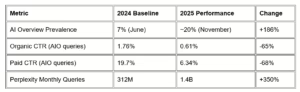
Let me put this in perspective with some data (us marketers love data): Google AI Overviews caused a 65% collapse in organic click-through rates this year. Meanwhile, AI-native search engine Perplexity grew 350% to 1.4 billion monthly queries. Those two numbers alone should make any digital marketer pause.
These aren’t incremental changes. This is a revolution happening in real-time, and most brands haven’t even noticed. From the frontline the pattern is clear: visibility isn’t disappearing, traffic is.
This piece is both a retrospective and a reset. We’ll look at what actually happened in SEO during 2025, why Generative Engine Optimisation (GEO) is now a distinct discipline rather than a buzzword, and what digital marketers need to prioritise going into 2026. So read on, before legacy metrics lead your team in the wrong direction.
2025’s SEO Earthquakes: What Actually Happened?
2025 was an especially volatile year, even for an industry as fast paced as organic search. For more than a decade, SEO has weathered constant change: Panda, Penguin, Medic updates, Helpful Content updates, and endless core algorithm refreshes. Each time, the fundamentals largely held. Create good content, earn trust, optimise technically, and you would be rewarded with visibility and traffic.
2025 was different.
This wasn’t just another algorithm update year, it was the point at which search stopped being a list of links and became an answer layer. AI didn’t just influence rankings; it intermediated the user journey itself. In many cases, users got what they needed without ever clicking through.
There were a total of 3 core updates in 2025, spaced fairly evenly apart. These updates were precision strikes designed to target low quality content.
March 2025 Core Update (March 13th – 27th)
The March update specifically targeted what Google calls “parasite SEO”, the practice of reputable sites hosting low-quality third-party content to game rankings. The update enhanced spam detection and refined content evaluation systems, particularly affecting sites relying on thin content or aggressive link-building tactics.
What really stood out? Google explicitly emphasised surfacing more content from individual creators throughout 2025. The algorithm started recognising and rewarding authentic expertise over corporate content mills. This meant content was more likely to be ranked based on its quality and originality, even if it was hosted on a smaller or less authoritative domain. It wasn’t altruism, it was necessity; AI systems needed clean, attributable sources, not content farms recycling the same ideas.
June 2025 Core Update (June 30th – July 17th)
The 2nd update of 2025 continued this trajectory, taking three weeks to roll out globally. This one shift towards AI-driven content understanding, enabling better recognition of context, tone, and genuine value beyond simple keyword matching.
The takeaway? Google got much better at distinguishing between content written by someone who actually knows what they’re talking about and content that’s just… well, words on a page.
December 2025 Core Update (December 11th – 29th)
The 3rd and final update of 2025 was more of a broad algorithm refresh that built upon the first two. During its rollout, Google stated on LinkedIn “This is a regular update designed to better surface relevant, satisfying content for searchers from all types of sites.” but in actual fact SERPs saw a high level of volatility and several established metrics saw their standards raised. This included core web vitals, user engagement metrics seeing heavier weighting and EEAT signals becoming even more significant across more industries than ever before.
The main point of all this was to ensure that AI generated content of poor quality saw its rankings decrease, while the sources for that AI content were prioritised.
AI Overviews Redefined the SERP
AI Overviews weren’t a new thing in 2025, but it was the year they became unavoidable. Both the quality of response and their prevalence increased significantly; in June 2024, AI Overviews were appearing for around 7% of searches, but by November 2025 that had increased to 20%. For informational queries in the business and technology sectors saw AIO coverage of more than 33%.
Whole industries saw shifts here too. Among the biggest changes in AIO appearances were entertainment (528% increase), restaurants (387%) and travel (381%). If you’re in one of those sectors and you’ve not adapted, you’re already invisible.
As a digital agency specialising in the travel industry, we’ve seen these changes firsthand. For users, they mean faster answers, but for marketers, they mean less clicks, even when rankings are stronger than ever. All is not lost for traditional search, however, because there’s a missing piece and it’s critical for your organic success in 2026: citation inclusion.
What is Citation Inclusion?
In marketing, citation inclusion is simply when a brand or web page is include in a generative response. These might be from an LLM or agentic AI like ChatGPT, Perplexity or Gemini. More importantly for organic search, it might be when a brand is cited in an AI Overview.
Why Does Citation Inclusion Matter?
Quite simply, it matters because it mitigates that decline: brands cited in AI Overviews received on average 35% more organic clicks and 91% more paid clicks than non-cited results. This has created a new visibility hierarchy, with AI firmly in control: either you’re in its answer or you’re nowhere
The Technical SEO Wake Up Call
Google issued warnings about JavaScript-heavy sites, noting that AI crawlers struggle with rendering and recommending server-side rendering strategies. Mobile-first indexing solidified as the primary evaluation method, with Core Web Vitals and user experience signals gaining prominence.
Interestingly, structured data importance diminished for certain markup types as Google simplified SERP visual enhancements. The focus shifted from technical markup to genuine content quality and user engagement.
Many marketers have thrown their hands up and simply declared that SEO is dead. This couldn’t be further from the truth. In fact, technical SEO isn’t dead at all; it’s become critical foundational infrastructure for AI consumption.
Generative Engine Optimisation is Now a Distinct Discipline
As humans, most of us have got a pretty deeply ingrained fear of change. It makes us go into survival mode or, even worse, shove our heads in the send and pretend like everything is normal. But things with search aren’t normal, far from it, and they’re changing faster than ever. While most of us were obsessing over Google’s next big core update as usual, AI-native search engines were achieving unprecedented growth.
The Explosion of AI-Native Platforms
There’s no better example to demonstrate this change than the meteoric rise of Perplexity AI. In May 2024, the AI powered answer engine was processing around 312 million monthly queries. By May 2025, that figure was 780 million, a year-over-year increase of 150%. The platform had targeted 1 billion weekly search queries by year end, though the figures to confirm whether they achieve this have not yet been released.
Perplexity didn’t just an increase in popularity; naturally, their market value also skyrocketed. In early 2023, they were valued at $150 million. By mid 2025, this had increased to over $14 billion. Today, the platform is valued at a massive $20 billion.
This isn’t an isolated case either, nor is the change purely an increase in the monetary value of AI. Rather, it’s a fundamental change in mainstream search behaviour. 70% of consumers already trust generative AI search results and this is predicted to rise to 79% this year.

The 3 Pillar GEO Framework
When AI first began to gain recognition, many marketers thought it would just be like another version of SEO. While there’s definitely some crossover, GEO has fully emerged as its own distinct discipline. Traditional search optimisation practices still hold true, but GEO isn’t just ‘SEO with AI keywords’, it’s specific optimisation for systems that synthesise answers, not rank pages.
Through our work across industries in 225, we’ve seen 3 core strategies emerge that are essential for AI visibility:
Semantic Footprint Expansion
Instead of targeting single keywords, publish content covering topic clusters and adjacent entities. AI systems use “query fan-out” capabilities (Patent: US11769017B1) to understand context, so your content needs to demonstrate comprehensive topical authority. You can think of this a bit like an extension to the switch from focussing on individual keywords to overall topics for organic search rankings.
The great news is that if you’ve been following the guidance from Google and the direction organic search has been going the last few years, you’re already in a great position to pivot from. If not, and you’re still targeting a couple of primary keywords in isolation per page, your organic strategy needs an urgent overhaul.
Fact-Density Enhancement
Add statistics, citations, and unique insights to increase information gain. AI systems prioritise fact-rich, authoritative sources. If your content is just regurgitating what’s already out there, AI will ignore it.
The content you create should reinforce your topical authority (or that of your clients, if you’re agency side). Make your content easy to process and understand for machines, but ensure it adds value for the users that read and engage with it. The old paradigm of writing for the user first and satisfying the machine in the process still holds true, we just need make sure the content can be accessed quickly if we want it included by AI.
The above said, you should avoid the temptation to repurpose your content to rank well in LLMs. Google’s Dany Sullivan recently spoke out about this, specifically discouraging marketers and website owners from turning their content into bite-sized chunks just for AI optimisation, Speaking on the Search Off the Record podcast, he said ‘we don’t want you to do that’ and confirmed that Google’s engineers shared the same view. They noted that this doesn’t work with Google Search and while it may net you a short term advantage for LLM visibility, their ranking systems will eventually catch up and get wise to these tactics. Instead, the content should be for the user first and foremost.
Structured Data Optimisation
Structured data has been a powerful tool for optimising search visibility for several years now. It’s also one of the earliest factors we’ve been able to identify as having a real impact on your AI visibility. Implementing comprehensive Schema.org datasets and merchant feeds improves the ability of tools powered by machine learning to parse your content. This gives you a massive advantage when AI agents simply don’t have the time to waste when generating a response to a prompt. If your content’s data isn’t easy for them to read, they’ll skip over it, move on and you’ll remain invisible. Align your content with knowledge graph entities that AI systems recognise and use them to full effect.
The takeaway? Don’t neglect your markup, schema especially. It’s relatively easy to implement and the impact can be huge for how little effort it requires.
Cross Platform Discovery Is On the Rise
Younger demographics increasingly use Reddit, TikTok, and Perplexity as primary discovery tools, fragmenting search behaviour beyond traditional Google queries. This shift requires brands to optimise for multiple AI platforms simultaneously rather than focusing solely on Google rankings. It should also be a wake up all that writing for machines was never and should never be the primary goal; optimising for so many platforms in one piece of content is impossible and creating multiple copies of that content, each tweaked for a different target, is spammy. Keeping the user the main focus at all times and reaping the rewards as a by product is the only approach that makes logical sense.
The Data That Should Keep You Up At Night
So this is easier to fully comprehend, here’s a table summarising the dramatic shifts that have happened over the last year for queries triggering AI Overviews:
Sources: Wordstream, Dataslayer and AppLabx
Let me translate what this means in real terms: for every 1,000 impressions, you’re losing 11 organic clicks and 134 paid clicks. That’s not a minor adjustment, that’s a fundamental breakdown of the traditional search model.
The algorithmic signals behind this shift also evolved. Searcher engagement rose to ~12% weighting, while internal linking fell to ~1%. The dominant factor has become consistent publication of satisfying content; Traffic volume has stopped being the primary signal of success and, as brands and marketers, we need to see this as a wake up call.
Our Predictions for 2026 – The Agentic Search Era
Based on everything we’ve seen so far and the way search is heading, here’s our predictions for what we can expect in 2026:
AI Mode to Become the Default Google Interface
Google’s AI Mode, currently a tab available in search that you’re prompted to try, will likely transition to become the primary search interface in 2026. This shift will complete the transformation from link-based to answer-based search, making traditional CTR metrics obsolete for informational queries.
What this means: Brands must optimise for share of voice and citation frequency rather than ranking positions.

Agentic Search and Bot-to-Bot Transactions
The rise of “agentic search” will accelerate, with users delegating tasks to AI assistants that conduct asynchronous, multi-step research. This will require:
- Machine-readable pricing data and inventory APIs for agent-to-agent negotiations
- Structured operational data enabling bots to schedule appointments and complete transactions without human intervention
- Asynchronous optimisation strategies since AI agents may initiate requests outside business hours
This has already begun in some sectors, most notably cryptocurrency and finance. AI bots are already trading cryptocurrency autonomously and at scale, using machine learning to analyse market data, adapt strategies and make trades without any direct intervention from humans. In fact, an estimated 60-70% of trades in major financial markets are now being handled by bots.
A Revolution of Advertising Formats
Both Google and ChatGPT will introduce ads directly within their AI responses. In the case of ChatGPT, this has arguably already begun (with a less than favourable reception!). OpenAI claim that these aren’t ads as they have no financial component to them, but at the very least they’re strong suggestions towards a particular brand or product. It’s only logical that this will be monetised in the very near future.
For Google, this is more likely to look like a direct integration of shopping ads and sponsored content directly within AI responses. Early tests suggest these formats will blend seamlessly with organic citations, and will require new measurement frameworks tracking visibility in AI contexts rather than traditional impression metrics.
Platform Fragmentation Will Intensify
To be fully present and visible to AI, you’ll need to optimise across multiple ecosystems. Perplexity are targeting 1 billion queries per week this year and ChatGPT is expanding its browsing capabilities. Meanwhile, there are industry specific AI tools emerging in many verticals, each of which will have their own methods of discovery and evaluation. Finally, we must remember the integration of AI into many social platforms (Reddit, TikTok and Meta being primary examples) that are now serving as primary discovery tools, especially for younger demographics.
Content Strategies Will Need To Evolve
Successful 2026 content strategies will need to prioritise creating content with unique statics and insights that AI can’t synthesise from existing sources. This will need to be aligned with recognised knowledge graph entities and use comprehensive markup language for easy parsing. For existing content, consistent, frequent updates will be essential to maintain ‘freshness’ signals that are critical for AI’s recent content preference
Measurement Paradigm Shift
Traditional KPIs will give way to AI-specific metrics:
- Citation Share of Voice: Percentage of AI responses citing your brand vs. competitors
- Authority Score: Composite measure of fact-density, semantic coverage, and structured data quality
- Conversion Quality: Focus on downstream conversions rather than traffic volume, as AI intermediates the user journey
- Zero-Click Value: Brand visibility and authority building even without direct clicks
Your 2026 GEO Action Plan
Immediate Actions (Q1 2026)
- Audit AI Visibility: Use log file analysis to identify current AI crawler behaviour and citation patterns. You’ll also want to ensure you’re monitoring the users these citations get you. At Talking Stick Digital, we use custom GA4 segments and create AI/LLM specific channels to track traffic from AI for our clients.
- Implement a GEO Framework: Deploy semantic footprint expansion and fact-density enhancement across top-performing content. Start with your highest-traffic pages and add unique statistics, expert quotes, and comprehensive citations.
- Structured Data Overhaul: Implement comprehensive Schema.org datasets aligned with knowledge graph entities. This isn’t just about basic markup anymore, it’s about creating machine-readable knowledge bases.
Medium-Term Initiatives (Q2-Q3 2026)
- Multi-Platform Optimisation: Develop presence on Perplexity, ChatGPT, and industry-specific AI tools. Each platform has different content preferences and citation patterns.
- Agent-Ready Infrastructure: Create machine-readable APIs for pricing, inventory, and scheduling. This is particularly crucial for e-commerce businesses who want to capitalise on bot-to-bot transactions.
- AI Response Tracking: Implement tools to monitor citation frequency and share of voice in AI-generated answers. New solutions are emerging all the time and, while many of these are still enterprise level, AI prompt tracking is becoming increasingly accessible to businesses of all sizes. With the way we measure success and KPIs fundamentally changes, so too must the tools we use to track this.
Long-Term Transformation (Q4 2026)
- Authority Building: Shift from content volume to information gain and unique research. Commission original studies and data analysis that AI cannot replicate.
- Predictive Content: Use AI tools to identify emerging topic clusters before they become competitive. Create content moats around nascent entities.
- Organisational AI Integration: Train teams on GEO principles and establish AI optimisation as a core competency, not an add-on service.
What This Means for Your Business
For Authority-Driven Brands (Travel, Media, Education)
The Opportunity: AI Overviews expanded 381% for travel queries and now dominate informational searches. If you publish authoritative, experience-based content, AI systems will cite you as their primary source.
The Strategy: Create comprehensive guides with unique data points that AI cannot synthesise: wildlife population statistics, seasonal pattern analysis, first-hand experience metrics, sustainability benchmarks. The more specific and data-rich, the more likely AI will treat you as the definitive source.
The Tactic: Implement structured data for articles, reviews, and local business markup. We’ve seen this increase AI citation rates by up to 40% for authority-driven clients.
For Transaction-Focused Businesses (E-commerce, Retail, SaaS)
The Challenge: Paid CTR dropped 68% for AIO queries. When AI answers product questions directly, traditional shopping ads get pushed down.
The Strategy: Optimise product feeds for AI shopping integrations within responses. The brands that thrive will be those with machine-readable pricing, real-time inventory data, and comprehensive merchant structured data.
The Tactic: Add merchant structured data and machine-readable pricing APIs. This is becoming non-negotiable for agentic search; if bots can’t read your data, they can’t recommend your products.
For Expertise-Based Services (B2B, Professional Services, Agencies)
The Opportunity: Informational queries in business/tech sectors exceed 33% AIO coverage. AI systems are desperate for authoritative, trustworthy sources on complex topics.
The Strategy: Publish original research, proprietary data, and expert analysis that AI cannot replicate. Thought leadership isn’t just a buzzword anymore, it’s vital if you want to be cited in AI-generated answers.
The Tactic: Focus on semantic footprint expansion around industry entities. Map your content to knowledge graph topics and build comprehensive topical authority that positions you as the go-to source in your niche.
The Bottom Line
2025 wasn’t just an evolution, it was a revolution. The 65% CTR collapse and the rise of AI-native search prove that discovery is now AI-mediated by default. Treating GEO as an SEO add-on will quietly erase visibility over time.
As a marketer, brand or business, you have 2 choices:
- Cling to traditional SEO and watch visibility erode as AI intermediates user journeys
- Embrace the agentic search era: optimise for machine readability, authority signals, and cross-platform presence
At Talking Stick Digital, we’ve already made our choice. We’re helping our clients navigate this transformation with data-driven GEO strategies that build lasting authority in an AI-mediated digital ecosystem.
The brands that thrive will be those providing unique, verifiable insights AI cannot generate independently. They’ll establish themselves as indispensable sources that AI systems must cite.
Ready to future-proof your search strategy? Get in touch today for a complimentary AI Visibility Audit. We’ll assess your current GEO readiness and identify 2026 opportunities specific to your sector. The future of search is already here, so let’s make sure you’re part of it.